





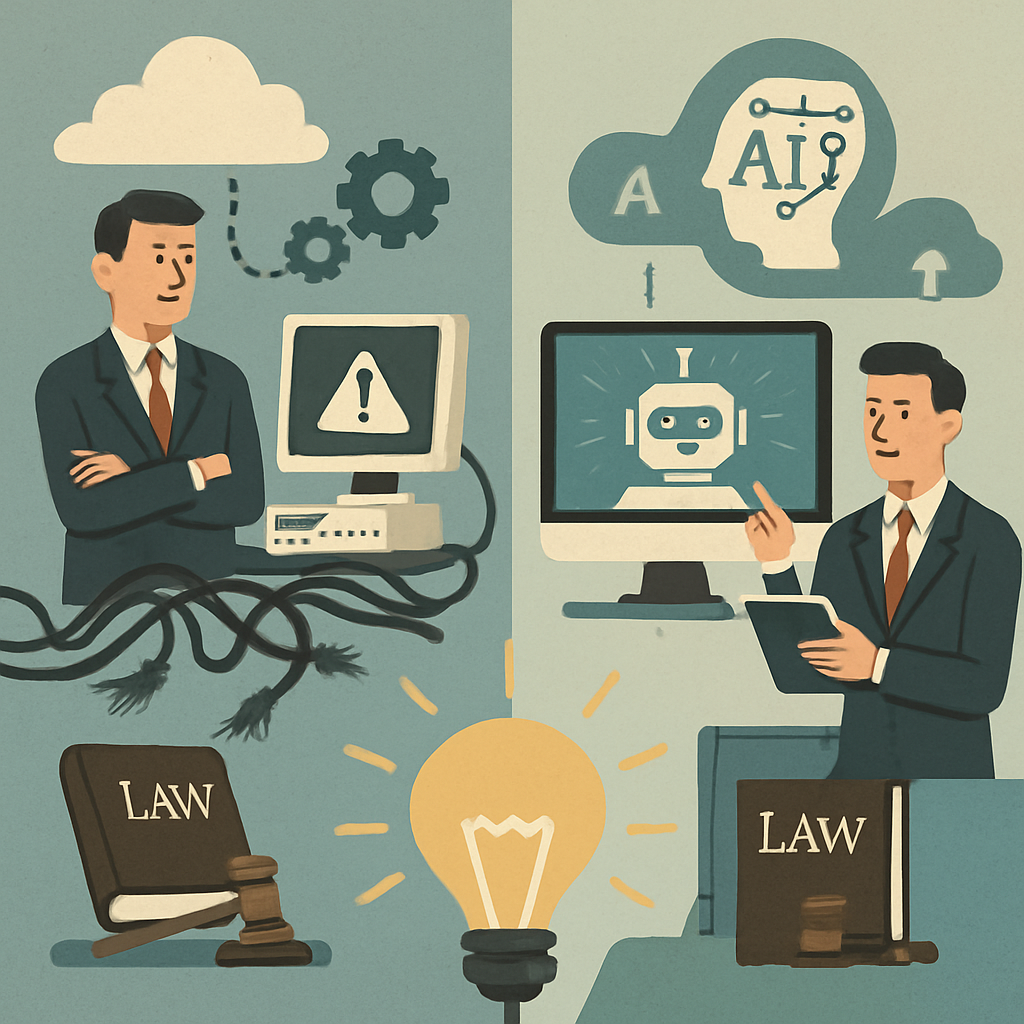
Why This Week’s AI Market Shock Is a Major Opportunity for Law Firms
Earlier this week, markets reacted sharply to news that a frontier AI company had released new legal-focused automation capabilities. Shares of...

3 min read
Jimi Gue
:
February 19, 2026
Artificial intelligence is transforming the legal industry. From contract review and litigation research to drafting and client communications, AI tools promise faster turnaround times and improved efficiency.
But there’s a growing problem inside many law firms that few leaders are actively managing: Shadow AI.
Just as “shadow IT” once referred to unsanctioned software used without approval, shadow AI describes employees using AI tools—often free or consumer-grade versions—without firm oversight, governance, or security review.
For law firms, the risks are significant.
What Is Shadow AI?
Shadow AI occurs when lawyers or staff use tools like generative AI chatbots, AI drafting assistants, or automated research platforms outside the firm’s approved technology stack.
It usually starts innocently:
A junior associate pastes a client contract into a public AI tool to summarize it.
A partner uses an AI chatbot to draft a motion outline.
A paralegal uses a free AI transcription tool for deposition notes.
There are real risks here:
Data may be stored externally.
It may be used to train third-party models.
It may fall outside attorney-client privilege protections.
It may violate confidentiality agreements.
Fabricated case citations
Incorrect legal standards
Outdated precedent
Misleading summaries
Data retention beyond firm policies
Lack of encryption controls
Weak access management
Exposure to third-party data processors
Lawyers are under intense time pressure. Ultimately AI tools are easy to access. Consumer tools are often more intuitive than enterprise systems.
Beyond policy, there are also foundational gaps in:
AI adoption isn’t just about selecting tools — it’s about governance, architecture, and operational clarity.
Generally there is no malicious intent. Just people looking for efficiency. But in a law firm, good intentions don’t reduce liability.
1. Client Confidentiality Breaches
Law firms handle highly sensitive information: trade secrets, M&A details, litigation strategies, personal data, privileged communications.
When lawyers input this information into unapproved AI platforms:
Even if the risk is “low,” the impact of a breach could be catastrophic.
2. Regulatory and Ethical Violations
Using AI tools without understanding how they process data—or without firm approval—can expose firms to ethical complaints or malpractice claims.
Several bar associations have already issued guidance requiring lawyers to understand the benefits and risks of AI. Shadow AI bypasses that obligation entirely.
3. Inaccurate or Fabricated Output (Hallucinations)
Without oversight, lawyers may unknowingly rely on flawed outputs. Courts have already sanctioned attorneys for submitting AI-generated fake citations.
Shadow AI increases the risk because there are no guardrails, review protocols, or approved workflows in place.
4. Data Security and Cyber Exposure
Consumer AI tools may not meet enterprise-grade security standards. Risks include:
For firms already under pressure from cyber threats, shadow AI creates an entirely new attack surface.
5. Reputational Damage
Clients increasingly ask about AI usage in RFPs and security questionnaires.
Imagine explaining to a major client that their sensitive litigation strategy was entered into a public chatbot without authorization.
The reputational damage alone could cost far more than the productivity gains ever delivered
Why Shadow AI Is So Hard to Control
Shadow AI grows quickly because:
When firms ban AI outright, usage simply goes underground.
The result: leadership believes AI isn’t being used—while in reality, it’s already embedded in daily workflows.
The solution isn’t prohibition. It’s governance.
Here’s a practical framework:
1. Establish a Clear AI Policy
Define: Make the policy practical and easy to follow.
2. Provide Approved, Secure Alternatives
If lawyers need AI for efficiency, give them enterprise-grade tools that:
If you don’t provide alternatives, shadow AI will fill the gap.
3. Train Lawyers on Responsible AI Use
Education reduces risk.
Train attorneys on: Competence includes technological competence.
4. Monitor and Audit Usage
Work with IT and risk teams to:
The goal isn’t punishment—it’s risk visibility
5. Involve Risk, IT, and Practice Leaders
AI governance should not sit solely with IT.
Shadow AI is a firm-wide issue, not a technical one.
The Strategic Opportunity
While shadow AI poses risks, it also signals something important: Your lawyers want better tools.
Final Thoughts
Shadow AI is already inside many law firms.
The question isn’t whether your attorneys are using AI—it’s whether you have visibility and control over how they’re using it.
In an industry built on trust, confidentiality, and precision, unmanaged AI usage is not just a technology issue.
It’s a governance issue.
And the firms that address it now will be the ones best positioned for the AI-driven future of legal services.
Earlier this week, markets reacted sharply to news that a frontier AI company had released new legal-focused automation capabilities. Shares of...

Artificial intelligence is already part of the legal industry-whether firms planned for it or not. Attorneys are experimenting with AI tools, clients...
By Matt Bares, Signal Consulting